“I have set watchmen upon thy walls, O Jerusalem, which shall never hold their peace day nor night.”
— Isaiah 62:6
There are moments when the Church must do more than observe what is happening in the nations. We must discern the times, take our place upon the walls, and ask the Holy Spirit what He is saying and how He is calling His people to pray.
I believe we are living in such a moment.
During my visits to Indonesia, something has continued to grow within me. What began as ministry, relationship and opportunity has increasingly become an intercessory burden.
I have returned from Indonesia not simply thinking about where I have preached or whom I have met, but carrying a deeper question:
What is God preparing to do across Indonesia and the Muslim world of Southeast Asia, and what responsibility does the Australian Church carry in preparing the way?
That question has also helped shape the book I am presently writing, Beyond the Middle East: Evangelism into the Muslim World of Southeast Asia.
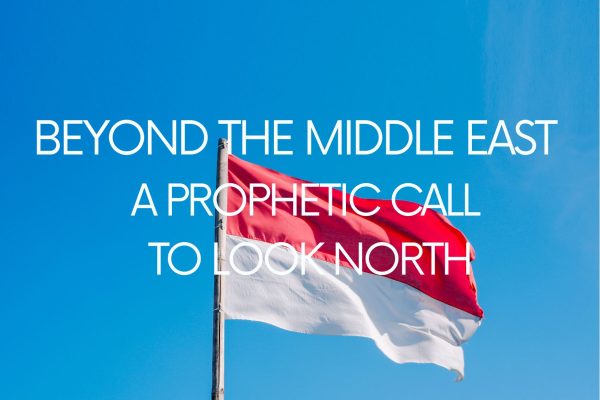
When Christians hear the words “the Muslim world,” our attention often turns immediately toward the Middle East. Yet immediately to Australia’s north lies Indonesia—the world’s largest Muslim-majority nation—and beyond it an enormous region containing nations, peoples and communities that must increasingly enter the prayer and mission vision of the Australian Church.
I believe the Holy Spirit is calling us to look north.
Not with fear. Not with political ambition. Not with cultural superiority. But with the eyes of watchmen.
THE WATCHMAN MUST SEE BEFORE OTHERS SEE
A watchman’s responsibility is not simply to react after something has happened. The watchman watches. The watchman listens. The watchman discerns movement on the horizon. And the watchman sounds the trumpet when it is time for others to awaken.
“I will stand upon my watch, and set me upon the tower, and will watch to see what he will say unto me.”
— Habakkuk 2:1
Prophetic intercession requires this posture. We do not merely pray according to yesterday’s headlines. We ask the Holy Spirit to reveal where prayer needs to be positioned for tomorrow.
This is one of the lessons that has become increasingly important to me through ministry in the nations. Sometimes the Church arrives after the battle has already begun. But intercessors are called to go ahead.
Prayer prepares the ground. Prayer opens doors. Prayer strengthens believers. Prayer covers pastors and evangelists. Prayer confronts spiritual resistance. Prayer prepares hearts. Prayer sends labourers.
Before there is a visible harvest, there is often an invisible work of intercession. That is why I believe Indonesia must become much more prominent upon the prayer radar of the Australian Church.
INDONESIA IS MORE THAN A MISSION FIELD
Every time I visit Indonesia, I am reminded that we cannot reduce a nation to statistics.
Indonesia is not simply a population number. It is people: families, children, students, pastors, businesspeople, farmers, workers, Muslims and Christians. People carrying dreams, disappointments, questions, fears and hopes. Most importantly, they are people whom God loves.
I have also encountered something that deeply encourages me: a Church that is alive.
There are pastors faithfully serving. There are believers hungry for God. There are Bible colleges preparing people for ministry. There are intercessors praying. There are leaders carrying vision for their cities and nation. There are Christians willing to stand for Jesus Christ in environments very different from those experienced by most Australian believers.
We must therefore be careful about the posture with which we approach Southeast Asia. Australia is not the great spiritual answer to Indonesia. Jesus is.
We are not called to control what God is doing there. We are called to recognise it, honour it, pray for it, strengthen it where invited, and stand alongside our brothers and sisters in Christ.
This must be Kingdom partnership rather than spiritual colonialism. The future harvest of Indonesia will ultimately require strong Indonesian believers, pastors, evangelists, intercessors and leaders. Our role may often be to help strengthen their hands.
WHY I AM WRITING BEYOND THE MIDDLE EAST
It is from these experiences, relationships and times of prayer that Beyond the Middle East: Evangelism into the Muslim World of Southeast Asia has begun to take shape.
The book is not being written simply because Southeast Asia represents an interesting missions subject. It has grown from a burden that has become stronger each time I have travelled into the region.
I have become increasingly convinced that much of the Western Church still carries an incomplete mental map of the Muslim world. We hear “Islam” or “Muslim nations,” and almost instinctively look toward the Middle East. Yet a vast part of the Muslim world is here in Asia, including immediately to Australia’s north.
Indonesia has forced me to look at that map differently.
My time with pastors, students, Christian leaders, churches and ministry partners has also reminded me that reaching nations cannot simply be a matter of arriving with a Western strategy. We must listen. We must learn. We must build relationships. We must pray. And we must strengthen indigenous believers who understand their own people, languages and cultures in ways an outsider never fully can.
The burden of the book, therefore, is bigger than evangelistic technique. It is a call for the Church to see the field differently, pray for it differently, and prepare differently for the harvest.
And for the Australian Church in particular, I believe that begins by looking north.
I BELIEVE THERE IS A SHAKING IN THE NATIONS
Across the world there is instability. Political systems are under pressure. Economies are shifting. Technology is transforming societies. Traditional cultural assumptions are being challenged. Generations are changing. Wars and rumours of wars continue. Natural events remind humanity how little control we actually possess.
Scripture tells us that shaking should not automatically produce fear in the people of God. Hebrews speaks of a Kingdom “which cannot be moved.” When everything that appears secure begins to move, the Church must know where it stands.
But prophetic people must also understand something else:
Shaking and harvest can exist in the same season.
Throughout Scripture, periods of upheaval often became moments in which God redirected people, opened unexpected doors and advanced His purposes.
Therefore, when we see nations being shaken, our first response should not simply be, “Lord, stop the shaking.” Sometimes our prayer must become: “Lord, what are You doing in the midst of this, and how should Your Church respond?”
We should never casually declare that every earthquake, volcano, economic crisis or political disturbance is a direct judgment from God. Scripture calls us to greater humility and discernment than that.
But neither should the Church be spiritually asleep when nations are moving. We must watch. We must pray. We must discern. And we must prepare.
THE BATTLE IS NOT AGAINST MUSLIMS
“For we wrestle not against flesh and blood, but against principalities, against powers, against the rulers of the darkness of this world, against spiritual wickedness in high places.”
— Ephesians 6:12
If we are going to contend prophetically for Indonesia and Southeast Asia, we must understand the nature of the battle.
Muslims are not our enemy. Islam cannot become an excuse for Christians to despise Muslim people. The Muslim family is not our enemy. The Muslim neighbour is not our enemy. The Muslim student is not our enemy. They are people Jesus died to save.
This distinction is foundational to genuine spiritual warfare. We contend against darkness while loving people. We resist deception while honouring people. We proclaim truth without hatred. We refuse compromise without abandoning compassion.
If our spiritual warfare causes us to hate the people we are supposedly praying for, something has gone terribly wrong.
Jesus looked upon lost humanity with compassion. So must we. Prophetic intercession must carry both authority and tears. There are times to decree the Word of God boldly, but there are also times when the intercessor must weep. We need both.
THE ALTAR MUST COME BEFORE THE PLATFORM
One of the dangers facing the modern Church is that we can become more interested in visible ministry than invisible intercession. But the great movements of God have never been sustained by platforms alone.
There must be an altar. There must be prayer that nobody sees. There must be fasting. There must be repentance. There must be consecration. There must be men and women willing to stand in the gap.
“And I sought for a man among them, that should make up the hedge, and stand in the gap before me for the land.”
— Ezekiel 22:30
This is the call of the intercessor. Before we ask, “Who will preach?” perhaps we must first ask: “Who will stand in the gap?”
Who will pray for Indonesia when nobody is watching? Who will pray for Southeast Asia when there is no conference attached to it? Who will pray for pastors whose names we may never know? Who will pray for Muslim families to encounter Jesus? Who will pray for dreams, visions and divine appointments? Who will pray for protection over believers? Who will pray for Bible colleges training future leaders? Who will pray for doors for the Gospel that human strategy cannot open? Who will contend until something moves?
AUSTRALIA MUST LOOK NORTH
I believe Australia’s geographic position carries a profound missional opportunity. We are located beside Asia and within the Pacific. Yet much of the Australian Church has historically looked culturally and spiritually toward Europe and North America.
Perhaps it is time to turn our eyes toward our own neighbourhood.
Look north: Indonesia, Malaysia, Singapore, Thailand, Cambodia, Vietnam, Myanmar, the Philippines—and beyond them, the enormous populations of Asia.
What if Australia has been positioned where it is partly so that the Church here can become a praying, sending, equipping and strengthening Church for our region?
That possibility should cause us to reconsider how we pray for revival. For years we have prayed, “Lord, send revival to Australia.” I continue to pray it. But I believe another sentence needs to be added:
Lord, revive Australia so that Australia can serve Your purposes among the nations.
Revival cannot terminate upon ourselves. If revival only produces larger meetings, we have misunderstood revival.
True revival should produce repentance, holiness, prayer, compassion, generosity, evangelism, missionaries, intercessors, and a renewed passion for the Great Commission.
PREPARE THE WAY OF THE LORD
There is a phrase that has repeatedly become important in my ministry: Prepare the way of the Lord.
“Prepare ye the way of the LORD, make straight in the desert a highway for our God.”
— Isaiah 40:3
John the Baptist carried this same cry. Preparation precedes visitation.
There are things the Church cannot manufacture. We cannot manufacture revival. We cannot manufacture conviction. We cannot manufacture genuine spiritual awakening. Only the Holy Spirit can transform the human heart.
But we can prepare. We can repent. We can pray. We can fast. We can preach truth. We can train labourers. We can build relationships. We can strengthen churches. We can send. We can go. And we can prepare the spiritual ground through sustained intercession.
This is part of the burden behind Contending for the Nations.
I increasingly believe that prayer movements and mission movements must come together. Intercession cannot remain disconnected from the Great Commission. And missions cannot depend entirely upon human strategy without the foundation of prayer.
Prayer prepares the way. Mission walks through the door.
THE HARVEST WILL REQUIRE PARTNERSHIP
“The harvest truly is plenteous, but the labourers are few.”
— Matthew 9:37
The harvest of Southeast Asia is too large for one denomination. Too large for one ministry. Too large for one nation. Too large for one generation.
This requires Kingdom partnership.
Australian churches standing with Indonesian churches. Intercessors standing with evangelists. Bible colleges training emerging leaders. Older ministers fathering and mothering younger ministers. Local believers reaching their own communities. International ministries serving without controlling. Prayer networks covering those on the front lines.
The day of building our own little kingdoms must end. The harvest belongs to Jesus.
A GENERATION IS WAITING
When I look across Southeast Asia, I am particularly conscious of the younger generation. They are connected to the world in ways previous generations were not. They are carrying smartphones. They are crossing cultural boundaries digitally. They are encountering ideas from around the world. They are asking questions. And spiritual battles are being fought for their hearts and minds.
The Church must not arrive twenty years late.
We need to pray now. We need to train now. We need to disciple now. We need to build relationships now. We need to strengthen indigenous leaders now. We need to prepare labourers now.
Lord, what must we establish in prayer today for the harvest You desire tomorrow?
STAND UPON THE WALL
This is my call to the intercessors reading The Trumpet Call.
Take your place. Do not underestimate the importance of your prayers because nobody sees them. Heaven sees.
Take Indonesia before the Lord. Take Southeast Asia before the Lord.
Pray for pastors. Pray for churches. Pray for Bible colleges. Pray for missionaries. Pray for evangelists. Pray for government leaders and authorities. Pray for peace and freedom for the Gospel to advance. Pray for Muslim families. Pray for divine encounters. Pray for the younger generation. Pray for labourers. Pray for Australia to recognise its responsibility.
And then listen. Intercession is not merely speaking. Watchmen also listen.
Ask the Holy Spirit: “What are You saying about these nations?” “Where do You want me to stand?” “What do You want me to pray?” “What must be prepared?” And perhaps most importantly: “Lord, are You asking me to go?”
“Whom shall I send, and who will go for us? … Here am I; send me.”
— Isaiah 6:8
I believe that question is still being asked.
The Muslim world is bigger than the Middle East. The harvest is closer than we think. Indonesia is at our doorstep. Southeast Asia is within our God-given neighbourhood.
The nations are moving. The harvest is ripening. The watchmen must take their place. The intercessors must stand in the gap. The labourers must be prepared. And the Australian Church must lift its eyes beyond its own shores.
Look north.
Stand upon the wall.
Sound the trumpet.
Contend for the nations.
Prepare the way of the Lord.